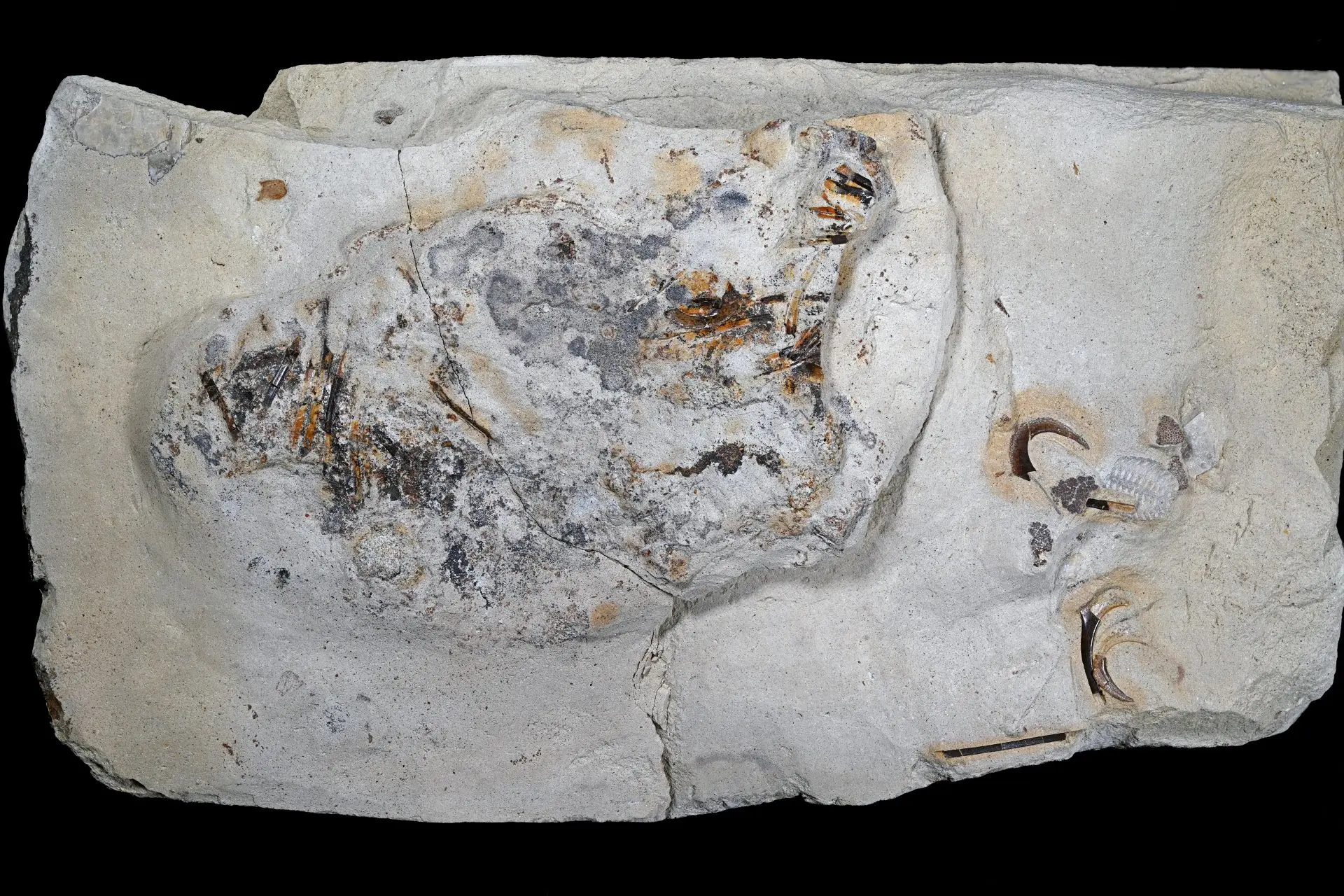

HERO IMAGE
Photograph of the Scalpellum burdigalense scutum alongside a life reconstruction of the complete stalked barnacle attached to a floating object or hard substrate.
HIGHLIGHTS
A single fossil plate discovered in northeastern Slovenia represents the country’s first confirmed stalked barnacle. Despite its modest appearance, it reveals an important marine connection between the Mediterranean and Central Paratethys during the Miocene.
overview
Stalked barnacles are among the least commonly preserved marine crustaceans. Unlike their familiar acorn barnacle relatives, their skeleton consists of numerous separate plates that usually fall apart soon after death, making complete fossils exceptionally rare. As a result, their fossil record is often fragmentary and easily overlooked.
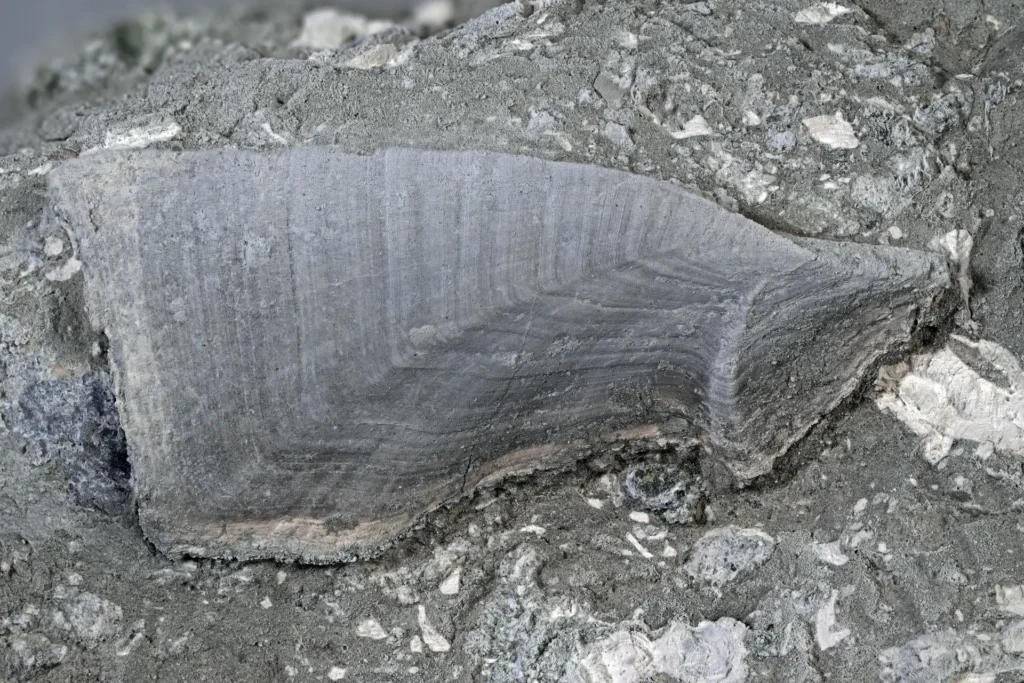
This study documents the first confirmed occurrence of the stalked barnacle Scalpellum burdigalense in Slovenia. The specimen, a beautifully preserved right scutum recovered from Middle Miocene deposits near Šentilj, extends the known geographical range of the species eastwards into the Central Paratethys. Previously, S. burdigalense was known only from France, Italy and Ukraine.
Although represented by only a single skeletal plate, the fossil provides important palaeobiogeographical evidence. During the Middle Miocene, the Slovenian Corridor connected the Mediterranean Sea with the Central Paratethys, allowing marine organisms to disperse between these basins. The new record confirms that stalked barnacles were among the many organisms using this seaway. The discovery also highlights how even isolated fossil remains can preserve valuable information about the evolution of marine faunas and the changing geography of ancient seas.
REFERENCE
Gašparič, R., Kočí T., Kočová Veselská, M., Hitij, T. & Žalohar, J. 2025: The pedunculate barnacle Scalpellum burdigalense Des Moulins, 1875 (Cirripedia, Scalpellidae) from Slovenia and its palaeogeographical significance. Neues Jahrbuch für Geologie und Paläontologie – Abhandlungen, 314 (2), 181-195.
Read the publication on ResearchGate.